
THE FIGHT TO FIGHT: One Battle After Another
By the time I started flying U.S Navy aircraft in 1986, women had been able to earn their wings at the flight training school near Pensacola, Florida, for over a decade. Still, my wings came with significant limitations due to sex-based policies.
Even though I graduated at the top of my class, as a woman my opportunities were limited. If selection had been solely merit-based, I would have been assigned a combat aircraft. As a woman, policy restricted me to serving in support roles – non-combat aircraft assigned to non-combat ships.
My first at-sea deployment was part of a 2-helicopter detachment aboard the USS Wabash, an oiler attached to the Carl Vinson Battle Group. For those six months, I was the only woman among 7,500 men.
Getting that deployment opportunity took more than a year, because at the time most ships did not want to deal with finding space to house a woman. I pressed hard to make this deployment happen, but because of the delay, my male peers deployed and advanced ahead of me.
During Desert Shield and Desert Storm I flew helicopters off an ammunition ship, resupplying the carriers with bombs. Over 40,000 women deployed for that conflict, and although we weren’t allowed in combat, we filled essential roles. Our performance in that operation helped drive repeal of the legal ban on women in combat aviation and aboard combat ships.
This experience with sex-based laws and restrictions left a deep mark on me throughout my Navy career. I found myself thinking about the brave women who broke gender barriers as personal heroes.
Heroic Trailblazers
One of my first heroes was Capt. Rosemary Mariner, a true trailblazer. Capt. Mariner was one of the first six women to earn her wings in the Navy’s flight training school in 1974. She became one of the first female Navy pilots to fly jets, and in 1991, she became the first woman to command an operational aviation squadron during Operation Desert Storm.
I had the opportunity to hear Capt. Mariner speak while I was still in active service. I will always remember her telling us about the importance of staying in service to “hold the door open” for the women behind us.
Even though I left the Navy in 1993, just before combat aviation opened to women, Capt. Mariner’s words have always stayed with me.
I continued to follow events in all branches of the military as opportunities for women slowly progressed. To me, each step of the way was an historic event and the trailblazing women who achieved them became my newest heroes.
Fast forward to today…Many of my personal heroes are helping me bring THE FIGHT TO FIGHT documentary to life.
Heading into the Home Stretch
The fight for women’s equality in the military is far from over, but THE FIGHT TO FIGHT documentary is now in its final phases.
I am learning that post-production filmmaking is a whirlwind of simultaneous activities. For example, we are now in the process of hiring sound design and color-correction studios, securing a final-cut editor, creating updated rough cuts, reviewing original music composition, finding a distributor and/or streamer, and more.
In addition, we are building a community and outreach network to help us plan an engagement and awareness campaign. Recently, Kris Fuhr and I appeared on Iowa Public Radio’s “River to River.” The radio show was prompted by the Pentagon review of women serving in ground combat positions, which is currently underway. Kris and I shared THE FIGHT TO FIGHT’s perspective that women have met the standards and have been serving successfully in these roles for a decade.
Our next opportunity for exposure arrives in just a couple of days at the Veterans Breakfast Club Story Fest ’26, which will take place on Friday, February 27, in Santa Monica, California.
Ellen Haring and I will be there to show clips of the film and appear on a panel with Army veterans Wednesday Nelson and Hannah Rozzi, two young women who smashed the brass ceiling in combat arms units.
More plans are also in the works. Our fiscal sponsor, Women in International Security (WIIS), has approached the Council on Foreign Relation to co-host a screening for Washington, D.C. policy makers. Co-producers Ellen Haring and Kris Fuhr will share clips at an event celebrating the 50th anniversary of women at West Point. Several other pre-release events are also being planned.
Reshaping Our Primary Goal
When I started the long journey to make THE FIGHT TO FIGHT, I intended the film to honor and celebrate my heroes, the brave women who broke through a ceiling that restricted opportunities and career paths for women. However, my original goal was overtaken by events and news coming out of the Pentagon.
The latest news involves a Pentagon review of women in ground combat roles that Senator Mazie Hirono of Hawaii calls “an attack on women” and a step that lays the groundwork for removing women from ground combat units.
On February 12, Sen. Hirono stated she is going to introduce a bill to codify the current DoD policy that holds all military positions open to women. Her statement came at a hearing where top enlisted leaders attested that women serving in combat units have not caused standards to lower. They also attested to their support for women serving in any role in the military, including combat arms, if they meet the standards.
Pushing for legislation championed by Sen. Hirono that keeps doors open for women is the best way to ensure the military is merit-based and not sex-based.
This process occurred in 1948 when Congress was pressed to enable women to serve in the peacetime military; in 1967, when legislation removed caps on rank and numbers; and in 1975, when legislation enabled women to attend military academies.
It is time to push for passage of a law that will, in the words of Capt. Mariner, “hold the door open” for women to serve in all military positions if they are qualified and meet all standards. In other words, we should press Congress to codify into law a military meritocracy based on equal standards for all positions.
This is a fight worth fighting for.
Joy Bronson served as a Naval Aviator from 1986 to 1993 and is the Director/Producer of THE FIGHT TO FIGHT documentary feature film.
Help Us Spread the Word
The Fight to Fight documentary is at a pivotal stage and needs to show it can reach a big audience to get the film widely distributed. Donations are critical at this point, and so is sharing our website link, blog and social media posts. So please spread the FIGHT TO FIGHT message to friends, family and colleagues who are veterans or people concerned about the future of our military and fair treatment for women. Click here to donate and here to sign up for our blog.

Iowa Public Radio: “The History and Future of Women in the Military” Features Film Team
Kris Fuhr and Joy Bronson appeared on Iowa Public Radio’s “River to River,” a radio news show that “digs into the story behind the headlines” and takes on “challenging topics.” The radio show, which is broadcast on 27 stations throughout Iowa, was prompted by the Pentagon review of women serving in ground combat positions, which is currently underway. Kris and Joy shared THE FIGHT TO FIGHT’s perspective that women have met the standards and have been serving successfully in these roles for a decade.
Graphic Courtesy of Iowa Public Radio
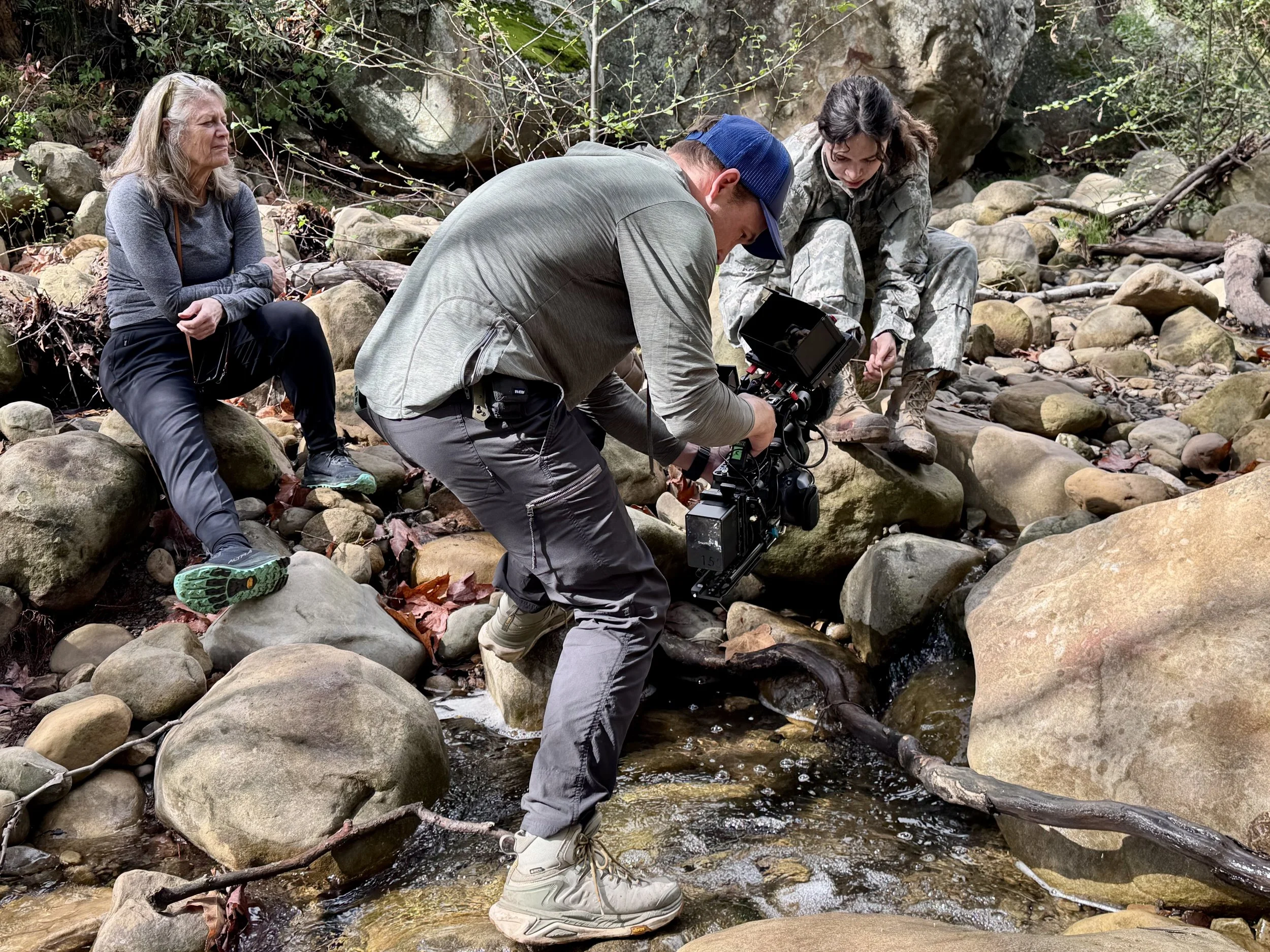
Bloody Boots Scene Filmed to Enliven Graphic Story about Surviving Ranger School
One of the most graphic stories in THE FIGHT TO FIGHT involves bloody boots and perseverance at Ranger School, where one of the first women to earn a Ranger Tab talks about her determination to succeed no matter what it takes. To help bring the on-screen interview to life, a small crew brought an actress with bloody boots to a local stream to shoot B-roll for the scene. Shown above from left to right: Joy Bronson, director/producer, Mark Romanov, editor/director of photography, and Ruby Lindsey, actor.
Photo Courtesy of Joe Skorupa